
Why You Struggle to Stick to Your Priorities (And What Helps)
Why is it so hard to stick to your priorities, even when you’re clear about what matters to you?
If you’ve ever felt frustrated, guilty or ashamed because you can’t seem to follow through on what you say is important, you’re not alone. Many people come to therapy wondering why they struggle with setting priorities in life, especially when work, family, health and expectations all compete for attention.
I’ve been thinking about this myself recently. I haven’t written a blog in a while, and I noticed a familiar feeling creeping in: guilt. Writing matters to me. It’s something I value. And yet I hadn’t made the time.
There’s something uncomfortable about knowing I want to do something and not doing it. I can see what matters and still I avoid it. Why is that?
As Ron Weasley famously said, “She needs to sort out her priorities.”
We tend to think the problem is poor discipline or bad time management. We tell ourselves we need to get better at prioritising. But what if the issue isn’t that we don’t know what matters?
What if the problem is that too many things matter?
When everything feels important, work, relationships, health, being available, being responsible, we end up trying to honour all of it at once. And when everything is a priority, nothing truly is.
So perhaps the real challenge isn’t having priorities.
It’s choosing a priority.
What Happens When You Focus on Just One Priority?
The first time I came across this idea was in Keller and Papasan’s book The One Thing. Their thesis is simple: instead of managing competing priorities, choose one.
This can feel tricky to think through.
“If my children are my priority and I drop everything else, how will I earn money to put food on the table?”
The idea isn’t tunnel vision “My children are the only thing I care about.” It’s more like donut vision (if that’s a thing).
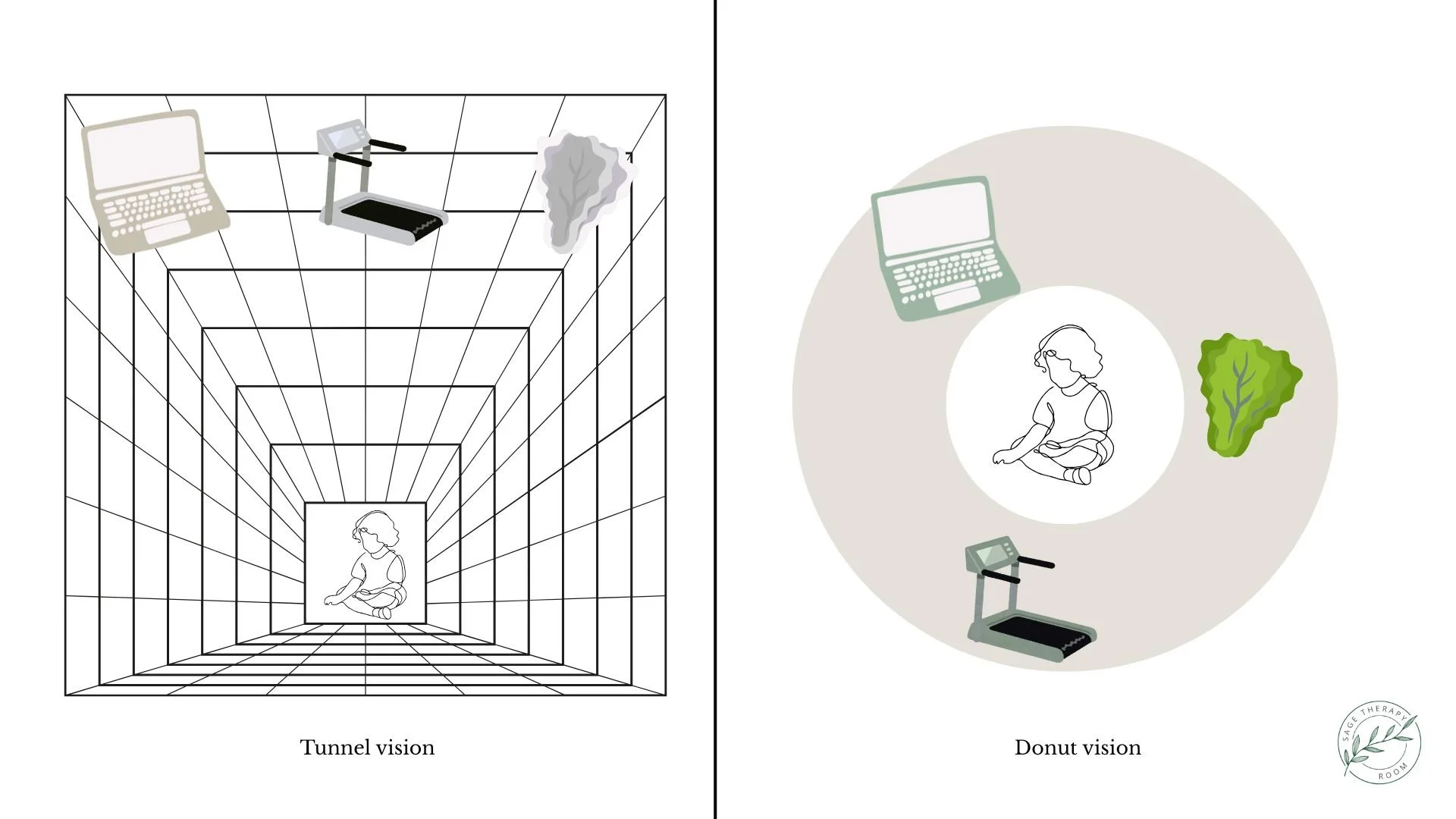
Tunnel vision vs donut vision: In tunnel vision, only one thing matters. In donut vision, everything orbits your priority; this allows for adaptation.
Your priority, whether that’s your children, your health, your work, or something else, becomes the central point. Everything else can then adapt around it.
Let’s look at an example. When you’re trying to hold multiple priorities (work, kids, gym, eating well), your evening might look like this:
6pm: Stay late at work because a report is due.
7pm: Rush to the gym.
8pm: Nip to the shops for a quick protein meal deal.
9pm: Get home. The kids are already in bed. Blow them a kiss through the door.
Now imagine you choose one priority. Let’s say it’s the gym.
5pm: Finish work on time so you can get to the gym.
6:30pm: Leave the gym and stop by the shops for fresh ingredients.
7pm: Cook a healthy meal you can enjoy with your family.
9pm: Early night so your body can rest and recover.
What’s lovely about this approach is that when you prioritise one thing, the question “What should I do?” often becomes clearer.
The Freedom in Adaptability
Another beautiful part of this approach is its flexibility. You don’t need to have the same priority all the time.
Maybe last month your children were your priority. This month, you’ve signed up for a 10K and need to train. Let running be the priority.
Arrive at work a little sweaty because you ran there and use the showers. Protect Saturday morning for park run. Heck, take the kids with you.
Priorities can shift. The key is choosing consciously.
How to Communicate Your Priorities Without Conflict
I also appreciate this approach because it can be clearly communicated:
“Sweetheart, I’d like running to be my priority this month. How can we adjust things so I can run on Saturdays?”
“I know eating healthily is your priority right now. Send me a shopping list and I’ll pick things up on the way home.”
There’s something relational about naming a priority. It invites collaboration rather than resentment.
Give It a Go
If there’s something you want to achieve soon, try writing it on a piece of paper and sticking it on the fridge. Let it be visible to you and to the people you live with. It can serve as a gentle reminder: this is the priority for now, and other things can adapt around it.
Ironically, writing this blog hasn’t been my priority this week or last. And yet, in not writing it, I found myself thinking about why. That reflection is what brought me back to the keyboard.
When we stop forcing ourselves to do everything, we can create space to return to what matters.
Try choosing one priority. See what shifts.
You may be surprised what happens.

Photo by Glenn Carstens-Peters on Unsplash